I am sorry that it has been weeks since my last post, but I have been busy getting back to Djibouti, completing my turnover as the Kenya Country Engineer, and then returning to Kenya. In the final days of the last trip to Kenya, we explored around Nairobi. The first stop was the Elephant Orphanage within the Nairobi National Park. For one hour a day they allow people into the compound to see the young elephants being fed and allow them to play in mud/water. All of these elephants were orphaned because their mothers or entire families were killed by poachers for their ivory. The wildlife rangers spend 24 hours straight with an elephant, feeding it every three hours and tending to all its needs, before rotating to another elephant. This is done to ensure that one does not get used to a single ranger.

Here is the younger elephants being led into the feeding area, they are between 5 and 15 months old.

This one is drinking human baby formula. They have found this is the best substitute for the young elephants, but did make the joke that it is very tough to get milk from a wild elephant mother.

After eating, the young quickly went to the pond and started to play and drink.

The youngest elephant, only 5 months old, would follow the shadow of the umbrella on this hot day. She was found lying against her mother, dead from poachers shooting her and removing her tusks.

It took awhile for it to happen, but soon all of the elephants were in the pond, pushing shoving, and spraying water.

After the younger ones were led away, the older (17-30 month) elephants were brought down for their feeding. This one was old enough to have the bases of tusks starting to emerge. These animals weighed over a thousand pounds.

These guys and gals were even more energetic; pushing, shoving, throwing dirt, and splashing.

After getting wet, they would get a trunk full of dirt and throw it onto their backs, or at their handlers, whichever suited their fancy at that moment.

This teenage elephant grabbed this stick to chew on, which the handlers made a valiant effort to take away, but the elephant won the law of gross tonnage and kept the stick.
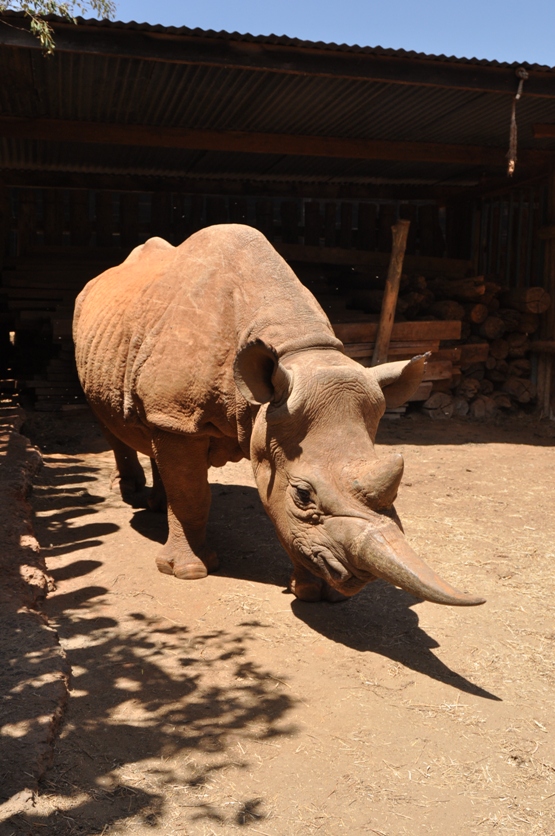
This orphanage also cares for rhinos on occasion. This juvenile black rhino was found next its dead mother, whose horn had been cut off with a chainsaw. They raised it here for two years before releasing it back into the park. They say every so often it returns to the pen where it was raised to just hang out. They lock it in when guests are around, but open the door and let it leave when it wants.

The rhino was now almost a ton in weight, and if it wanted to leave this wood and steel door enclosure, it could at any second.

You could see that this young boy had lived a tough life so far, and the rangers were really hopeful that it would adapt to the wild, be accepted, and one day mate with a wild female to assist the engaged population.

The next stop was the giraffe park, where you can hand feed these gentle giants. When you are up close, these things are monsters. Though the park is extremely large, most stay near the feeding stand for obvious reasons.

This young one came over to the low feeding area where Kate and I were. He saw the bucket of pellets and made a beeline right for where we were.

Here is Kate feeding the young one. They are very gentle and just pick up the feed pellets with their lips.

Me posing with the giraffe. Its concern was not the composition of the photograph, it only cared about the food.

One of the adult males came over from the tall feeding area to our area after seeing how much food the young one was getting. It walked over, scaring the young one away, and then leaned down quickly at Kate. The sheer size of the head approaching her quickly frightened her, but the goliath just nibbled the pellets and went back to the tall feeding stand.


We both went over to the tall feeding stand to pose with the large male again.


Kate also got very familiar with this adult female. She (the giraffe) had been trained to lick a pellet out of a person’s lips.

This family of warthogs came in and quickly cleaned up the pellets that were dropped by the giraffes.
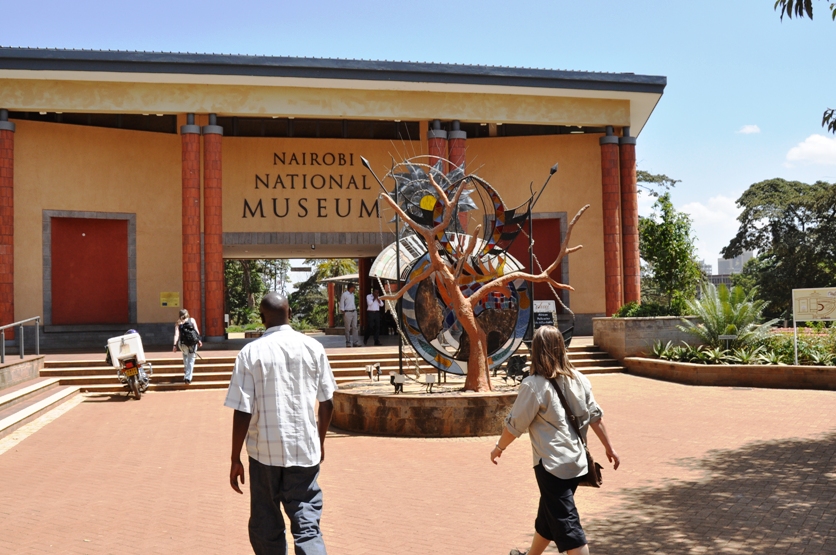
Our next stop was the Nairobi National Museum. It was very impressive, breaking the history of Kenya down into three segments, pre-colonial, colonial, and post-colonial. It’s very humbling coming from North America, where our history can be measured in thousands of years, to Kenya where their history goes back 18 million, with the first humanoids. The museum also had a hall of birds and some other stuffed animals.

The most fun part was the snake park. There were terrariums all around with a full range of snakes, but the most interesting feature was a sunken snake pit. Within this pit were hundreds of snakes, both venomous and non-venomous.

There was also a tortoise pit, where the tortoises were doing what they do best. This male was relentless, and in the two hours we were there, completed at least one and a half laps around the pit, chasing and propositions the females.

An African python wrapped around my head.

Kate was not so excited about this part of the tour.

This snake had just finished eating a lizard, within minutes it was swallowed and into its midsection.

This was the most awesome snake I have ever seen, the Gaboon Viper… it is only about 3 feet long about and 4-6 inches in diameter with a head that is nearly the size of your palm. When we walked to its terrarium, it puffed/inflated in defense.


